I’d like to share the story of a new project, and how it came to be.
A few years ago, a friend gave me a copy of Marie Howe’s beautiful poem, What the Living Do, which she wrote for her brother, John, after he died of AIDS. The poem illuminates the banal everyday moments that make up a life — opening the car door, carrying groceries, buying a hairbrush — and renders them sacred.
In March, I started working with a new collaborator, Greg Hochmuth. I showed him the poem, and we talked about trying to make a digital artwork that could approach its level of beauty, using evidence of everyday life collected from the Internet.
We started with the idea of simultaneity — at any given moment, all of the human bodies blinking, breathing, bathing, biting, etc. We built a system to employ anonymous Internet workers to identify examples of 100 different human bodily behaviors within YouTube videos. In this way, we crowdsourced the collection of 10,000 two-second video clips, paying $0.20 per clip.
With these videos, we hoped to make something beautiful, showing our common humanity. But instead, we found the videos lacked diversity, and depicted only a small homogenous sliver of human life. We spent several months gathering additional data, experimenting with different designs, trying to squeeze something beautiful out of this material, but no matter what we tried, we couldn’t find a way.
Disheartened, we decided to abandon the project and four months of work, and we met for breakfast to talk about our decision. In that conversation, we realized we were both experiencing similar states of mind: distracted, anxious, alienated, lonely, numb. We had set out to make a project about our common humanity, but we felt less human than ever. And then we realized: maybe our project is not a celebration of human beauty, but a portrait of human delusion — an exploration of the Internet’s psychological effect on humanity.
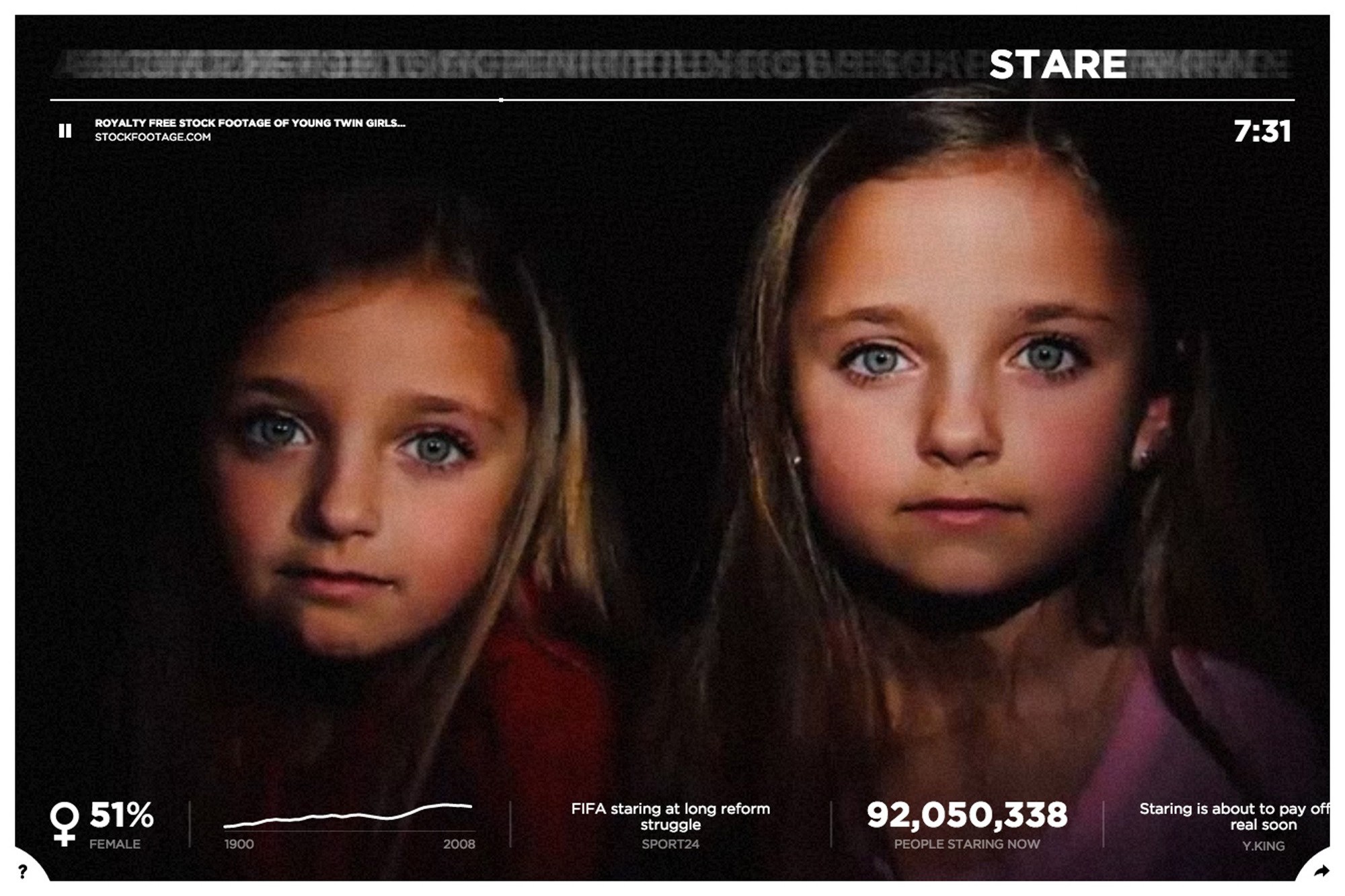
We changed the name to Network Effect, and started adding elements to make it feel even more overwhelming. We gathered 10,000 Twitter tweets mentioning the 100 behaviors, and had Amazon Mechanical Turk workers read them aloud while recording their voices into their cellphones. We mixed the 10,000 resulting MP3s into 100 multilayered soundscapes, one for each behavior. We used the Google Books corpus to generate historical usage graphs and gender breakdowns for each behavior over the last 100 years. We used Google News to generate an archive of news headlines for each behavior since 2004. We used Mechanical Turk to perform “wisdom of the crowds” surveys to approximate the total number of people doing each behavior at any particular moment on earth, and to guess the top ten brands associated with each behavior. We used Twitter to generate an ongoing archive of “reasons” and “definitions” for each behavior, based on tweets that mention “I [cry] because...” and “[crying] is...” respectively.
We gathered a vast amount of data, which is presented in a classically designed data visualization environment — all real, all impeccably annotated, all scientifically accurate, all “interesting,” and yet all basically absurd. In this way, the project calls into question the current cult of Big Data, which has become a kind of religion for atheists.
Network Effect has too many components to list here, and that is precisely the point — you can never see it all. In fact, you only have around seven minutes to see it (based on the average life expectancy in your country), and then you will be blocked for twenty-four hours, inducing a feeling of anxiety and a fear of missing out — feelings common to Internet use.
The Internet is a miraculous tool, but all too often, it affects us like a drug. Many of its popular apps, news websites, and social networks have been carefully designed to addict and distract, so they can harvest human attention like the natural resource it is. “Keep searching and you will discover,” these services seem to proclaim, but the deepest truths cannot be found by searching — and you will not find them in data, in videos, or in images of other people’s lives.
We need time and space and silence to remember who we are, who we once were, and who we can become.
There is a way, and every one of us contains the potential to find it.
You will not find it here: http://networkeffect.io
Happy fall.
Jonathan

